Introduction
If you’re considering full-mouth dental implants, one of the first questions you’ll likely ask is: “Should I choose All on 4 vs All on 6 Dental Implants?” Both are proven treatment options designed to replace an entire arch of missing or failing teeth with a fixed prosthesis. However, choosing the right option isn’t simply about selecting the treatment with more implants.
When comparing All on 4 vs All on 6 Dental Implants Vijayawada, the best choice depends on several important factors, including the amount and quality of your jawbone, your chewing forces, long-term treatment goals, overall oral health, and budget. While All on 4 uses four strategically placed implants to support a full-arch prosthesis, All on 6 uses six implants to provide additional support and distribute chewing forces more evenly. Both techniques have excellent success rates when recommended for the right patient.
This guide explains the key differences between All on 4 vs All on 6 Dental Implants Vijayawada, including implant support, bone requirements, immediate loading, long-term durability, cost considerations, and who may be a suitable candidate for each treatment. You’ll also learn how modern digital planning, computer-guided implant surgery, and advanced implant techniques help many patients achieve fixed teeth while avoiding unnecessary procedures whenever clinically appropriate.
By the end of this article, you’ll have a clear understanding of how implant specialists determine whether All on 4 or All on 6 Dental Implants is the most suitable solution for restoring your smile, chewing function, and long-term oral health.
Key Takeaways
- All on 4 vs All on 6 Dental Implants Vijayawada are both proven solutions for replacing a full arch of missing or failing teeth with fixed prosthetic teeth.
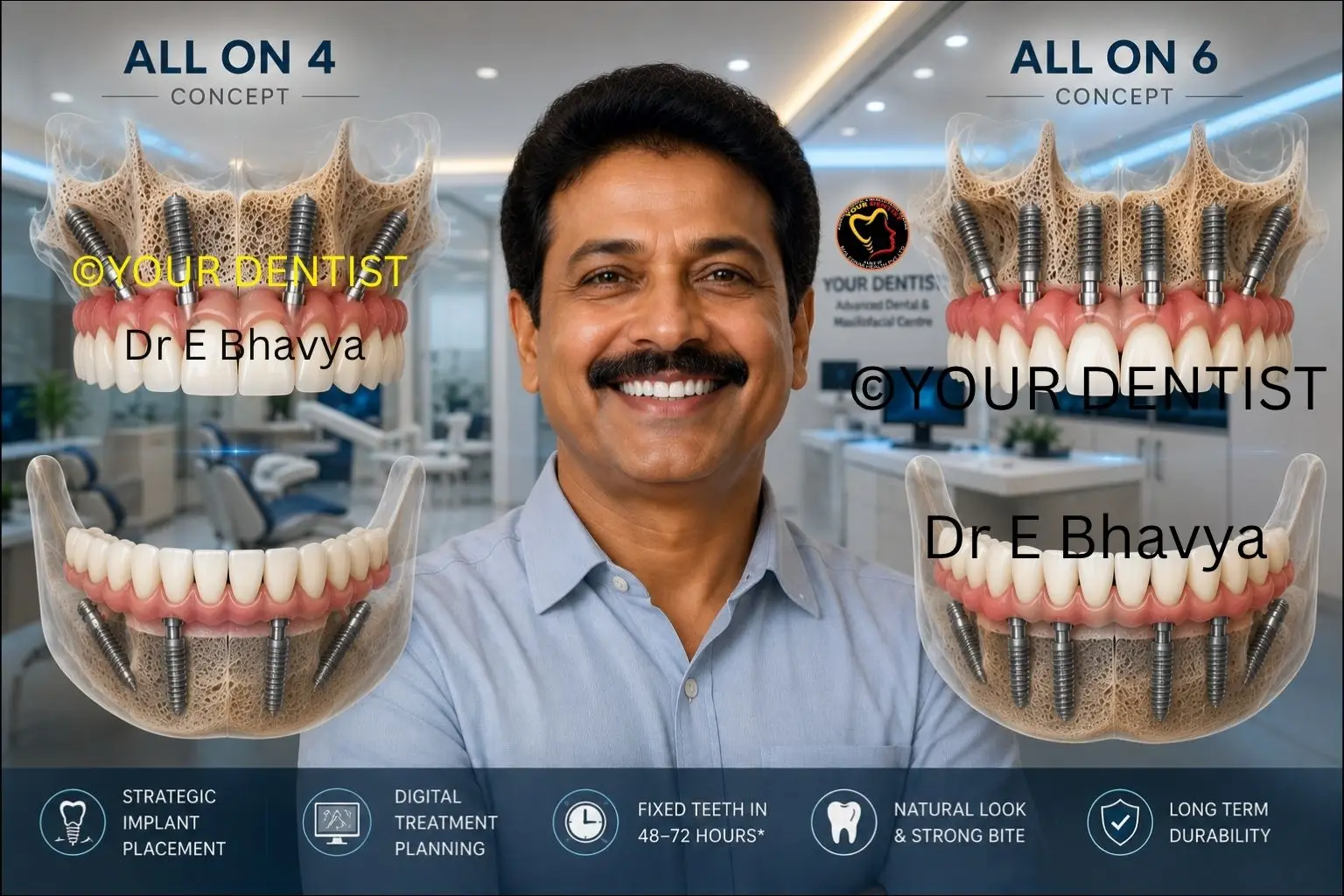
- All on 4 uses four strategically placed implants, while All on 6 uses six implants to provide additional support and improved force distribution.
- Neither treatment is universally better—the right choice depends on bone availability, chewing forces, oral health, long-term goals, and budget.
- Both treatment options can often be planned using CBCT imaging, digital treatment planning, and computer-guided implant surgery for greater precision and predictability.
- In many suitable cases, advanced implant techniques may allow patients to receive fixed teeth without extensive bone grafting.
- A comprehensive clinical examination and CBCT scan help the implant specialist determine whether All on 4 or All on 6 Dental Implants is the most appropriate treatment for each patient.
What Are All on 4 vs All on 6 Dental Implants Vijayawada?
All on 4 and All on 6 Dental Implants Vijayawada are advanced full-mouth teeth replacement solutions designed for patients who have lost most or all of their teeth or have multiple severely damaged teeth that cannot be saved. Instead of replacing each missing tooth with an individual implant, these treatment concepts use a strategically planned number of dental implants to support a fixed full-arch prosthesis, restoring both function and aesthetics.

All on 4 Dental Implants use four strategically placed dental implants to support a full arch of fixed replacement teeth in either the upper or lower jaw. The implants are positioned at carefully planned angles to maximize the use of available bone, often allowing many patients to receive full-mouth rehabilitation without extensive bone grafting when clinically appropriate. This treatment is widely recognized as a predictable and cost-effective solution for full-mouth restoration.
All on 6 Dental Implants follow the same treatment concept but use six dental implants to support the full-arch prosthesis. The two additional implants provide extra support, improve the distribution of chewing forces, and enhance the overall stability of the restoration. Depending on the patient’s bone quality and treatment requirements, advanced implant techniques such as Pterygoid Implants or Zygomatic Implants may also be incorporated to achieve secure anchorage in cases of significant bone loss.
Although the primary difference is the number of implants used, choosing between All on 4 and All on 6 Dental Implants Vijayawada is not simply a matter of selecting more implants. The ideal treatment depends on several clinical factors, including the amount and quality of available jawbone, bite forces, overall oral health, functional requirements, and long-term treatment goals. A comprehensive clinical examination and digital treatment planning help determine which option is most suitable for each patient.
Quick Comparison: All on 4 vs All on 6
Both All on 4 vs All on 6 Dental Implants Vijayawada are proven full-mouth rehabilitation solutions that restore fixed teeth using dental implants. While they share the same treatment goal, they differ in the number of implants used, the amount of available bone required, force distribution, cost, and long-term treatment planning. The table below provides a quick overview to help you understand the main differences before exploring each aspect in more detail.
| Number of Implants | Four dental implants support one full arch. | Six dental implants support one full arch. |
| Bone Requirement | Generally requires less available bone. | Usually requires more available bone to accommodate two additional implants. |
| Chewing Force Distribution | Excellent support with good force distribution. | Improved force distribution because the load is shared across six implants. |
| Arch Stability | Highly stable for suitable candidates. | Provides additional stability and support for the prosthesis. |
| Immediate Loading | Can often support immediate loading when clinically appropriate. | Frequently well suited for immediate loading because of additional implant support, when clinically appropriate. |
| Cantilever Length | May require a longer cantilever depending on the treatment plan. | Typically allows a shorter cantilever because of the additional implants. |
| Long-Term Support | Excellent long-term success with proper case selection and maintenance. | Provides additional long-term prosthetic support by distributing forces across more implants. |
| Cost | Generally more cost-effective because fewer implants and components are required. | Usually costs more due to additional implants and prosthetic components. |
| Ideal Candidates | Patients with moderate bone availability seeking a predictable and cost-effective full-mouth solution. | Patients with adequate bone volume or those who may benefit from additional implant support for long-term function. |
Important: More implants do not automatically mean a better treatment. The most suitable option depends on your jawbone, bite, oral health, functional requirements, and long-term treatment goals. A comprehensive clinical examination and CBCT scan help determine whether All on 4 vs All on 6 Dental Implants Vijayawada are the right choice for you.
9 Key Differences Between All on 4 and All on 6
Although All on 4 vs All on 6 Dental Implants are designed to restore a full arch of missing teeth, they differ in several important ways. Understanding these differences can help you make an informed decision and appreciate why implant specialists recommend one treatment over the other based on your individual clinical condition.

1. Number of Dental Implants
The most obvious difference is the number of implants used to support the full-arch prosthesis.
All on 4 uses four strategically placed dental implants, while All on 6 uses six implants. The additional two implants in the All on 6 concept provide extra anchorage and support for the prosthesis.
However, more implants do not automatically mean a better treatment. The ideal number of implants depends on the patient’s bone availability, functional requirements, and overall treatment plan.
2. Bone Requirement
The amount and quality of available jawbone play a major role in selecting the appropriate treatment.
Because All on 4 uses fewer implants, it can often be planned in patients with moderate bone loss by strategically utilizing the available bone. In contrast, All on 6 generally requires additional bone to accommodate two extra implants, although advanced techniques such as Pterygoid Implants or Zygomatic Implants may allow treatment even in patients with significant bone loss.
A CBCT scan helps determine which option is suitable based on your individual bone anatomy.
3. Cantilever Effect
A cantilever is the portion of the prosthesis that extends beyond the last supporting implant.
In some All on 4 cases, a slightly longer cantilever may be required depending on the patient’s anatomy and treatment design. With All on 6, the additional implants often allow the prosthesis to be supported over a greater length of the jaw, reducing the cantilever and improving force distribution.
Proper digital planning is essential to minimize unnecessary stress on the prosthesis and implants.
4. Chewing Efficiency
One of the primary goals of full-mouth dental implants is restoring comfortable chewing.
Both All on 4 and All on 6 can provide excellent chewing function. However, the additional support provided by six implants may improve chewing efficiency and prosthetic stability in suitable patients, particularly those with stronger bite forces or higher functional demands.
The choice depends on the patient’s chewing habits, bite pattern, and overall treatment goals.
5. Force Distribution
Every time you bite or chew, pressure is transferred through the prosthesis to the supporting implants.
With All on 6, these forces are distributed across six implants instead of four, reducing the load placed on each individual implant. This balanced distribution may contribute to improved prosthetic support and long-term stability in appropriately selected cases.
Even so, All on 4 has demonstrated excellent long-term clinical success when carefully planned and executed.
6. Immediate Loading
Many patients want fixed teeth as quickly as possible after implant surgery.
Both All on 4 and All on 6 can often support immediate loading, allowing a temporary fixed prosthesis to be placed on the same day or within a few days when adequate implant stability is achieved.
The decision between immediate and delayed loading depends on factors such as bone quality, implant stability, and the patient’s overall clinical condition—not simply on the number of implants placed.
7. Long-Term Durability
Long-term success depends on much more than the implant design alone.
Factors such as surgical planning, bone quality, prosthetic design, oral hygiene, regular maintenance, and systemic health all contribute to the longevity of implant treatment.
While All on 6 may provide additional prosthetic support because of the extra implants, both treatment concepts have excellent long-term success rates when performed for the right patient and maintained properly.
8. Cost
Treatment cost is an important consideration for many patients.
Because All on 4 uses fewer implants and fewer prosthetic components, it is generally a more cost-effective option. All on 6 usually involves additional implants, components, and a more complex treatment plan, which may increase the overall cost.
However, treatment should never be chosen based on cost alone. The most appropriate option is the one that offers the best long-term outcome for your individual clinical needs.
9. Ideal Candidate
There is no single treatment that is best for everyone.
All on 4 may be recommended for patients seeking a predictable, cost-effective full-mouth solution with moderate available bone. All on 6 may be considered for patients with adequate bone support, higher functional demands, or situations where additional implant support is expected to provide long-term benefits.
Ultimately, the decision is made after a comprehensive clinical examination, CBCT evaluation, digital treatment planning, and a discussion of your treatment goals and expectations with your implant specialist.
Section Summary
The differences between All on 4 vs All on 6 Dental Implants Vijayawada extend beyond simply using four or six implants. Factors such as bone availability, force distribution, cantilever length, chewing efficiency, immediate loading, long-term durability, and overall treatment objectives all influence which approach is most suitable. Rather than asking “Which treatment is better?”, the more important question is “Which treatment is better for my individual clinical condition?” That answer can only be determined through careful evaluation and personalized treatment planning.
How Is Treatment Planned?
Successful All on 4 vs All on 6 Dental Implants Vijayawada begin long before the actual implant surgery. Careful treatment planning is one of the most important factors in achieving predictable, long-lasting results. Every patient has a unique jawbone anatomy, bite, medical history, and treatment goals, so no two treatment plans are exactly the same.
Before recommending All on 4 vs All on 6 Dental Implants Vijayawada, the implant specialist performs a comprehensive clinical evaluation and uses advanced digital technology to determine the most appropriate treatment approach.

1. Clinical Examination
The first step is a detailed clinical examination of your oral health and overall condition. This helps the implant specialist understand the current condition of your mouth and identify any factors that may influence treatment planning.
During the examination, the following are carefully evaluated:
- Remaining natural teeth
- Gum health
- Amount of bone loss
- Smile line
- Bite (occlusion)
- Jaw relationship
- Chewing forces
- Signs of teeth grinding (bruxism)
- Overall oral hygiene
This examination provides the foundation for developing a personalized treatment plan.
2. Digital Imaging and CBCT Scan
Modern implant dentistry relies heavily on advanced digital imaging to accurately assess the jawbone before surgery.
Depending on the patient’s needs, diagnostic imaging may include:
- OPG (Orthopantomogram)
- CBCT (Cone Beam Computed Tomography)
- Intraoral digital scan
A CBCT scan provides a three-dimensional view of the jaws, allowing the implant specialist to evaluate:
- Bone height
- Bone width
- Bone density
- Bone quality
- Position of important nerves
- Maxillary sinus anatomy
- Available bone for implant placement
This detailed information helps determine whether All on 4 vs All on 6 Dental Implants Vijayawada are the most suitable option and whether advanced implant techniques may be beneficial.
3. Digital Treatment Planning
After collecting all clinical and radiographic information, every aspect of the treatment is digitally planned before surgery.
Digital planning allows the implant specialist to determine:
- Number of implants required
- Ideal implant positions
- Implant length and diameter
- Implant angulation
- Position of the future prosthetic teeth
- Overall bite and force distribution
Planning everything digitally before surgery improves precision and helps create a more predictable treatment outcome.
4. Computer Guided Implant Surgery
For many suitable cases, computer-guided implant surgery is used to transfer the digital treatment plan accurately to the patient’s mouth.
A custom-designed surgical guide helps position each implant according to the pre-planned angulation and depth while avoiding important anatomical structures.
Potential advantages of computer-guided implant surgery include:
- Greater surgical precision
- More predictable implant placement
- Reduced surgical trauma
- Less bleeding
- Flapless surgery in suitable cases
- Stitchless surgery when clinically appropriate
- Improved patient comfort
- Faster recovery in selected cases
The use of a surgical guide depends on the individual clinical situation and the treatment objectives.
5. Medical Evaluation Before Surgery
Dental implants require careful consideration of the patient’s overall health.
Before treatment, the implant specialist reviews the patient’s:
- Medical history
- Dental history
- Current medications
- Previous surgeries
- Allergies
- Lifestyle habits such as smoking
If required, additional investigations such as blood tests may be advised to ensure the patient is medically fit for implant surgery.
Particular attention is given to conditions such as:
- Diabetes
- Hypertension
- Heart disease
- Osteoporosis
- Autoimmune disorders
- Bleeding disorders
Managing these conditions appropriately helps improve safety and long-term treatment success.
6. Personalized Treatment Planning
After completing the clinical examination, CBCT analysis, digital planning, and medical evaluation, the implant specialist develops a treatment plan tailored to the individual patient.
The final recommendation is based on several important factors, including:
- Bone availability
- Bone quality
- Functional requirements
- Bite forces
- Smile aesthetics
- Immediate or delayed loading
- Long-term treatment goals
- Budget and patient expectations
Only after carefully evaluating all these factors does the specialist determine whether All on 4 vs All on 6 Dental Implants Vijayawada are the most appropriate option for restoring the patient’s smile and oral function.
Section Summary
The success of All on 4 vs All on 6 Dental Implants Vijayawada depends on far more than the surgical procedure itself. Comprehensive clinical evaluation, advanced CBCT imaging, digital treatment planning, and computer-guided implant surgery allow implant specialists to design a treatment plan that is precise, predictable, and personalized. Rather than following a one-size-fits-all approach, every decision is based on the patient’s unique anatomy, oral health, and long-term treatment goals.
Can Patients Receive Fixed Teeth Immediately?
One of the most common questions patients ask before choosing All on 4 vs All on 6 Dental Implants Vijayawada is whether they can receive fixed teeth immediately after implant surgery.
The answer is yes—for many patients, immediate loading is possible when the implants achieve adequate primary stability and the clinical conditions are suitable. However, not every patient is an ideal candidate for immediate loading. The decision depends on factors such as bone quality, implant stability, overall oral health, and the personalized treatment plan developed by the implant specialist.
When immediate loading is appropriate, patients may receive a temporary fixed prosthesis on the same day or within a few days after implant placement. This allows them to leave the clinic with fixed teeth while the implants continue to heal and integrate with the jawbone.

What Is Immediate Loading?
Immediate loading is a treatment protocol in which a temporary fixed prosthesis is attached to the dental implants shortly after surgery instead of waiting several months for complete healing.
This approach offers several potential benefits, including:
- Fixed teeth soon after implant placement.
- Improved smile and facial appearance.
- Better speech and chewing compared with removable dentures.
- Greater confidence during the healing period.
- Reduced number of treatment stages.
Although immediate loading is highly successful in appropriately selected patients, it is only recommended when the implants achieve sufficient stability and the surrounding bone can support the temporary restoration.
When Is Delayed Loading Recommended?
In some situations, the implant specialist may recommend delayed loading instead of immediate loading.
This may be appropriate when:
- Bone quality is insufficient for immediate loading.
- Additional healing is required after tooth extraction.
- Primary implant stability is not adequate.
- Extensive bone loss requires a more cautious approach.
- Certain medical or clinical conditions may affect healing.
During this healing phase, the implants undergo osseointegration, the natural process in which the jawbone grows around the implant surface to create a strong and stable foundation for the final prosthesis.
How Modern Technology Supports Faster Treatment?
Advances in digital implant dentistry have made immediate loading more predictable for many patients.
Modern treatment planning may include:
- CBCT three-dimensional imaging.
- Digital treatment planning.
- Computer-guided implant surgery.
- Intraoral digital scanning.
- Precision surgical guides.
- Multi-unit abutments.
- Screw-retained temporary prostheses.
These technologies allow implant placement to be planned with exceptional precision, improving efficiency while helping preserve healthy bone and surrounding tissues.
Temporary Teeth Before the Final Prosthesis
When immediate loading is performed, the first set of teeth is usually a temporary fixed prosthesis.
After the implants have fully integrated with the jawbone—typically over the following months—the temporary restoration is replaced with the final prosthesis, which may be fabricated using materials such as:
- Zirconia bridges
- Hybrid prostheses
- DMLS/PFM restorations
The final restoration is carefully customized to match the patient’s:
- Smile aesthetics
- Tooth shape
- Tooth colour
- Bite (occlusion)
- Chewing function
The goal is to achieve a restoration that is both natural-looking and highly functional.
Can All on 4 and All on 6 Be Done Without Bone Grafting?
One of the biggest concerns patients have before undergoing All on 4 vs All on 6 Dental Implants Vijayawada is whether they will need a bone graft. Many people assume that significant bone loss automatically means additional surgeries and a longer treatment period.
The good news is that bone grafting is not required for every patient. With modern implant dentistry, many patients can successfully receive All on 4 vs All on 6 Dental Implants Vijayawada without extensive bone grafting, provided there is sufficient healthy bone available for stable implant placement.
The decision depends on a detailed clinical examination, CBCT scan, and digital treatment planning. These evaluations help the implant specialist identify the strongest areas of the jawbone and determine the most predictable treatment approach for each patient.

How Can Bone Grafting Sometimes Be Avoided?
Modern implant techniques focus on making the best use of the patient’s existing bone rather than automatically rebuilding lost bone.
For many suitable patients, implant specialists can strategically place implants in areas with better bone quality and density, reducing or eliminating the need for conventional bone grafting.
Depending on the patient’s clinical condition, advanced treatment approaches may include:
- Strategic implant positioning.
- Angled implant placement.
- Computer-guided implant surgery.
- Remote anchorage techniques using stronger areas of bone.
These approaches help maximize the available bone while maintaining excellent implant stability when clinically appropriate.
Advanced Implant Techniques for Severe Bone Loss
Patients with advanced jawbone loss are not automatically excluded from receiving fixed teeth.
When conventional implant placement is not possible, advanced implant solutions may be considered, including:
- Pterygoid Implants, which utilize the dense pterygoid bone at the back of the upper jaw.
- Zygomatic Implants, which anchor into the cheekbone (zygoma) in cases of severe upper jaw bone loss.
- Other advanced implant approaches recommended by the implant specialist based on the patient’s anatomy.
These specialized techniques allow many patients with significant bone loss to receive fixed implant-supported teeth while avoiding extensive bone grafting whenever clinically appropriate.
Does This Mean Bone Grafting Is Never Needed?
No.
Although many patients can receive All on 4 vs All on 6 Dental Implants Vijayawada without bone grafting, there are situations where a bone graft remains the most appropriate treatment option.
The decision depends on several important factors, including:
- Bone volume.
- Bone quality.
- Implant stability.
- Functional requirements.
- Overall oral and systemic health.
- Long-term treatment goals.
The objective is not to avoid bone grafting at all costs, but to recommend the treatment that provides the safest, most predictable, and longest-lasting outcome for each individual patient.
Learn More About Dental Implants Without Bone Grafting
If you’re specifically concerned about whether bone grafting can be avoided, we have a dedicated guide that explains:
- Why bone grafting is traditionally recommended.
- Modern alternatives to conventional bone grafting.
- Advanced implant techniques used for patients with bone loss.
- How implant specialists determine the most suitable treatment approach.
(Internal Link: Dental Implants Without Bone Grafting)
Section Summary
Many patients undergoing All on 4 vs All on 6 Dental Implants Vijayawada can receive fixed teeth without extensive bone grafting, thanks to advances in digital planning, strategic implant placement, and modern implant techniques. However, every case is different. A comprehensive clinical examination and CBCT evaluation help determine whether bone grafting can be avoided or whether it remains the most appropriate option for achieving a safe, predictable, and long-lasting result.
How Do Doctors Decide Between All on 4 vs All on 6 Dental Implants Vijayawada?
Choosing between All on 4 vs All on 6 Dental Implants is never based on the number of implants alone. While many patients assume that placing more implants automatically provides a better result, experienced implant specialists know that the most successful treatment is the one that is carefully matched to the patient’s unique clinical condition.
Before recommending either treatment, the implant specialist performs a comprehensive evaluation to understand the patient’s oral health, jawbone anatomy, functional requirements, and long-term treatment goals. Every decision is based on achieving a stable, predictable, and long-lasting outcome rather than simply choosing one treatment concept over another.

1. Clinical Examination
The first step is a detailed clinical examination of the patient’s oral condition.
During this evaluation, the implant specialist carefully assesses:
- Remaining teeth, if present.
- Gum health.
- Amount of bone loss.
- Smile line.
- Bite (occlusion).
- Jaw relationship.
- Chewing pattern.
- Teeth grinding (bruxism).
- Overall oral hygiene.
These findings help determine the complexity of the case and identify the factors that may influence implant planning.
2. CBCT Scan and Digital Evaluation
A CBCT (Cone Beam Computed Tomography) scan plays a vital role in treatment planning because it provides a detailed three-dimensional view of the patient’s jawbone.
The scan allows the implant specialist to evaluate:
- Bone height.
- Bone width.
- Bone density.
- Available bone for implant placement.
- Position of important nerves.
- Maxillary sinus anatomy.
- Areas suitable for implant anchorage.
Using this information, the specialist can determine whether the available bone is sufficient for All on 4, whether All on 6 would provide additional support, or whether advanced implant techniques should be considered.
3. Functional Requirements
Not every patient places the same demands on their teeth.
Some patients have:
- Strong chewing muscles.
- Heavy biting forces.
- Teeth grinding (bruxism).
- Higher functional demands.
In these situations, the implant specialist considers how chewing forces will be distributed across the prosthesis and whether additional implant support would provide greater long-term stability.
The goal is to design a restoration that functions comfortably while minimizing unnecessary stress on both the implants and the prosthesis.
4. Bone Availability and Implant Support For All on 4 vs All on 6 Dental Implants Vijayawada
The quantity and quality of the remaining jawbone are among the most important factors influencing treatment selection.
When sufficient healthy bone is available, All on 6 Dental Implants may be considered to provide additional prosthetic support.
When bone availability is more limited, All on 4 Dental Implants can often make strategic use of the remaining bone without compromising treatment outcomes.
If conventional implant placement is not feasible, advanced options such as Pterygoid Implants or Zygomatic Implants may also be considered depending on the patient’s anatomy.
5. Patient Expectations and Treatment Goals
Successful implant treatment is not determined by clinical findings alone.
The implant specialist also discusses the patient’s:
- Expectations.
- Lifestyle.
- Functional needs.
- Smile goals.
- Budget.
- Preference for immediate or delayed loading.
These conversations help ensure that the recommended treatment aligns with both the patient’s clinical needs and personal expectations.
6. Personalized Treatment Recommendation
After completing the clinical examination, CBCT analysis, digital planning, and patient consultation, the implant specialist develops a personalized treatment plan.
The final recommendation is based on the combination of:
- Clinical findings.
- Bone quality and quantity.
- Functional requirements.
- Long-term prognosis.
- Patient expectations.
- Overall treatment objectives.
Rather than asking, “Which treatment is better?”, the focus becomes “Which treatment will provide the safest, most predictable, and longest-lasting outcome for this individual patient?”
Section Summary
There is no universal answer to whether All on 4 vs All on 6 Dental Implants are the better option. The decision is based on a careful evaluation of your jawbone, bite, oral health, medical history, functional requirements, and long-term goals. Modern diagnostic tools such as CBCT imaging and digital treatment planning allow implant specialists to recommend the treatment that offers the best balance of stability, function, aesthetics, and long-term success for each individual patient.
Myth vs Fact
There are many misconceptions surrounding All on 4 vs All on 6 Dental Implants Vijayawada. Some patients assume that more implants automatically mean better results, while others believe they must undergo bone grafting before receiving fixed teeth. In reality, the most appropriate treatment depends on careful clinical evaluation rather than common myths.
Let’s separate fact from fiction.
Myth 1: “All on 6 Is Always Better Than All on 4”
Fact:
No. All on 6 is not automatically better simply because it uses more implants.
Both treatment concepts have excellent clinical success when planned for the right patient. While All on 6 provides additional implant support and improved force distribution, All on 4 remains a highly predictable and successful solution for many patients with moderate bone availability.
The best treatment is determined by your bone quality, functional requirements, oral health, and long-term treatment goals—not by the number of implants alone.
Myth 2: “More Implants Always Mean Longer-Lasting Results”
Fact:
Long-term success depends on much more than the number of implants.
Factors such as:
- Accurate diagnosis.
- Bone quality.
- Surgical technique.
- Prosthetic design.
- Oral hygiene.
- Regular maintenance.
- Overall health.
all play an important role in determining how well the implants perform over time.
Additional implants may improve support in selected patients, but they do not guarantee a better outcome.
Myth 3: “Bone Grafting Is Always Required Before All on 4 or All on 6”
Fact:
Not necessarily.
Modern implant dentistry often allows patients to receive All on 4 vs All on 6 Dental Implants Vijayawada without extensive bone grafting by strategically utilizing the available bone.
Advanced treatment approaches such as computer-guided implant surgery, Pterygoid Implants, and Zygomatic Implants may help avoid conventional bone grafting in many suitable cases.
However, every patient is different, and some individuals may still benefit from bone grafting when it offers the most predictable long-term result.
Myth 4: “Everyone Can Receive Fixed Teeth on the Same Day”
Fact:
Immediate loading is possible for many patients—but not for everyone.
Whether fixed teeth can be placed immediately depends on:
- Bone quality.
- Implant stability.
- Overall oral health.
- Clinical findings.
- The treatment plan.
When immediate loading is not appropriate, a delayed loading approach may provide a safer and more predictable outcome.
Myth 5: “Cost Should Decide Which Treatment You Choose”
Fact:
Cost is an important consideration, but it should never be the only deciding factor.
Choosing a treatment solely because it costs less—or because it uses more implants—may not provide the best long-term outcome.
The most successful treatment is one that matches your clinical condition, functional needs, and long-term expectations.
Myth 6: “The Same Treatment Works for Every Patient”
Fact:
No two patients are exactly alike.
Every person has a unique combination of:
- Bone volume.
- Bone density.
- Bite.
- Smile aesthetics.
- Medical history.
- Functional requirements.
- Personal expectations.
For this reason, treatment planning is always individualized. A comprehensive clinical examination and CBCT scan help determine whether All on 4, All on 6, or another advanced implant solution is the most appropriate option.
Bottom Line
When comparing All on 4 vs All on 6 Dental Implants Vijayawada, it’s important to rely on clinical evidence rather than common misconceptions. The right treatment is not determined by the number of implants, treatment cost, or information found online. Instead, it is based on a comprehensive examination, advanced digital planning, and a personalized recommendation from an experienced implant specialist. The ultimate goal is to provide a treatment that is safe, predictable, functional, and designed to deliver long-term success for your individual needs.
Real Patient Cases
Every patient has a unique combination of bone availability, oral health, functional requirements, and treatment goals. That’s why All on 4 vs All on 6 Dental Implants Vijayawada are never selected using a one-size-fits-all approach.
At YOUR DENTIST Advanced Dental & Maxillofacial Centre, every treatment begins with a comprehensive clinical examination, CBCT imaging, and digital treatment planning. This personalized approach allows our implant specialists to recommend the treatment that offers the best long-term outcome for each individual patient.
Over the years, our team has successfully restored smiles for patients with a wide range of clinical conditions—from moderate bone loss to complex cases requiring advanced implant techniques.
Examples of Cases We Commonly Treat
Our clinical experience includes patients with:
- Complete tooth loss in one or both jaws.
- Severe jawbone resorption.
- Loose or uncomfortable dentures.
- Multiple failing teeth requiring full-mouth rehabilitation.
- Failed dental implants needing replacement.
- Complex cases requiring Pterygoid or Zygomatic Implants.
- Patients seeking immediate fixed teeth where clinically appropriate.
Each case is carefully planned based on the patient’s anatomy and long-term treatment goals rather than following a standard treatment protocol.
Why Every Case Is Different
Two patients with similar-looking smiles may require completely different treatment plans.
For example:
- One patient with adequate bone support may achieve excellent results with All on 4 Dental Implants.
- Another patient with higher bite forces or greater bone availability may benefit from All on 6 Dental Implants.
- A patient with severe upper jaw bone loss may require advanced solutions such as Zygomatic Implants or Pterygoid Implants instead of conventional implant placement.
This is why treatment recommendations can vary even when patients have similar concerns.
Explore Our Real Implant Transformations
Seeing real patient results can help you better understand what is possible with modern implant dentistry.
Explore our implant case studies to see:
- Before-and-after photographs.
- CBCT-based treatment planning.
- Implant placement techniques.
- Smile transformations.
- Full-mouth rehabilitation cases.
- Advanced implant solutions for complex bone loss.
Section Summary
Real patient cases demonstrate that successful implant treatment is never based on choosing All on 4 or All on 6 alone. Instead, each treatment plan is tailored to the patient’s bone condition, functional needs, and long-term goals. By combining detailed diagnostics, digital planning, and clinical expertise, implant specialists can recommend the most appropriate solution for achieving stable, functional, and natural-looking results.
Why Choose YOUR DENTIST for Full-Mouth Dental Implants?
Choosing between All on 4 vs All on 6 Dental Implants Vijayawada is only part of the decision. Equally important is selecting an implant team with the expertise, technology, and clinical experience to plan and perform your treatment safely and predictably.
At YOUR DENTIST Advanced Dental & Maxillofacial Centre, every full-mouth implant case is approached with meticulous planning, advanced digital technology, and a personalized treatment strategy designed around each patient’s unique needs. From straightforward cases to complex rehabilitations involving severe bone loss, our goal is to provide stable, functional, and natural-looking smiles that last for years to come.

Experienced Implant Team
Full-mouth dental implant rehabilitation requires careful diagnosis, precise surgical execution, and coordinated prosthetic planning.
Led by Dr. E. Surendranath, MDS (Oral & Maxillofacial Surgery) & Implantologist, our team has extensive experience managing a wide range of implant cases, including:
- All on 4 Dental Implants
- All on 6 Dental Implants
- Full-mouth rehabilitation
- Immediate loading protocols
- Failed dental implant revisions
- Advanced implant procedures for severe bone loss
Every treatment plan is developed with long-term function, stability, and patient comfort in mind.
Advanced Digital Implant Dentistry
Accurate diagnosis is the foundation of successful implant treatment.
Our digital workflow includes advanced technologies such as:
- CBCT three-dimensional imaging
- Intraoral digital scanning
- Computer-guided implant surgery
- Digital treatment planning
- CAD/CAM technology
- In-house 3D printing for surgical guides when indicated
These technologies allow implants to be planned with exceptional precision while improving efficiency and predictability throughout the treatment process.
Advanced Solutions for Complex Cases
Not every patient has sufficient bone for conventional implant placement.
Our team also offers advanced treatment options for patients with significant jawbone loss, including:
- Pterygoid Implants
- Zygomatic Implants
- Strategic implant placement techniques
- Bone grafting when clinically indicated
This enables us to provide treatment solutions for many patients who may previously have been told they were not suitable candidates for fixed dental implants.
Complete Treatment Under One Roof
From your initial consultation to your final smile, every stage of treatment is coordinated within our facility.
Our comprehensive workflow includes:
- Consultation and diagnosis
- CBCT evaluation
- Digital treatment planning
- Implant surgery
- Prosthetic design
- In-house CAD/CAM laboratory support
- Long-term maintenance and follow-up care
Having these services integrated helps improve communication, quality control, and continuity of care throughout your treatment journey.
Personalized Treatment, Never a One-Size-Fits-All Approach
No two patients have the same oral condition, bone anatomy, or treatment goals.
Rather than recommending the same solution for everyone, we carefully evaluate:
- Bone quality and quantity
- Bite and chewing forces
- Smile aesthetics
- Medical history
- Functional needs
- Long-term expectations
Whether All on 4, All on 6, or an advanced implant solution is recommended, every treatment plan is customized to achieve the safest and most predictable outcome for the individual patient.
Our Commitment to Patient-Centred Care
We believe that informed patients make confident decisions.
That’s why we take the time to explain:
- Your diagnosis
- Available treatment options
- Benefits and limitations of each approach
- Expected treatment timeline
- Long-term maintenance requirements
Our objective is not simply to place dental implants but to help every patient regain comfortable function, confidence, and an improved quality of life through evidence-based care.
Ready to Find the Right Full-Mouth Implant Solution?
If you’re considering All on 4 vs All on 6 Dental Implants Vijayawada, the first step is a comprehensive consultation and CBCT evaluation. This allows us to assess your oral health, discuss your goals, and recommend the treatment option best suited to your individual needs.
Book a consultation with YOUR DENTIST Advanced Dental & Maxillofacial Centre to discover which full-mouth implant solution is right for you.
At a Glance: Which Option Is Better for You?
If you’re still wondering whether All on 4 or All on 6 Dental Implants Vijayawada are the better choice, here’s a quick summary to help you understand when each treatment may be recommended. Remember, the final decision should always be based on a comprehensive clinical examination, CBCT imaging, and personalized treatment planning.
| Have moderate bone availability and are looking for a predictable full-mouth solution | All on 4 Dental Implants |
| Have sufficient bone volume and may benefit from additional implant support | All on 6 Dental Implants |
| Want fixed teeth and may be suitable for immediate loading | Either treatment, depending on implant stability and clinical evaluation |
| Have significant jawbone loss | Advanced implant solutions such as Pterygoid Implants, Zygomatic Implants, or other personalized treatment options |
| Are concerned about avoiding bone grafting | A treatment plan that makes strategic use of the available bone whenever clinically appropriate |
| Want the most appropriate long-term solution | A personalized recommendation based on your oral health, bone condition, bite, and treatment goals |
The Bottom Line
There is no universal winner in the comparison between All on 4 and All on 6 Dental Implants Vijayawada.
For some patients, All on 4 offers an excellent balance of stability, function, and efficient use of the available bone. For others, All on 6 may provide additional implant support and improved force distribution that better suits their clinical needs.
The right choice depends on factors such as:
- Bone quality and quantity
- Bite and chewing forces
- Overall oral health
- Functional requirements
- Long-term treatment goals
- Clinical findings from a CBCT scan
Rather than asking, “Which treatment is better?”, the more important question is:
“Which treatment is better for my specific condition?”
That answer can only be determined after a thorough clinical examination and personalized treatment planning by an experienced implant specialist.
Conclusion
Choosing between All on 4 vs All on 6 Dental Implants Vijayawada is an important decision, but it isn’t simply about selecting the treatment that uses more or fewer implants. The most successful outcomes come from choosing the solution that best matches your individual bone condition, oral health, functional needs, and long-term goals.
Throughout this guide, you’ve learned that both treatment concepts are proven and predictable when recommended for the right patient. Factors such as bone quality, bite forces, implant stability, and digital treatment planning all play a vital role in determining which approach is most appropriate. In some cases, advanced implant techniques or bone grafting may also be considered to achieve the best possible result.
The key takeaway is simple: there is no one-size-fits-all answer. A comprehensive clinical examination, CBCT scan, and personalized treatment plan are essential for identifying the most suitable full-mouth implant solution.
At YOUR DENTIST Advanced Dental & Maxillofacial Centre, we combine advanced digital technology, evidence-based treatment planning, and extensive clinical experience to help patients regain comfortable function, confident smiles, and long-lasting oral health.
If you’re considering All on 4 vs All on 6 Dental Implants Vijayawada and would like to know which option is right for you, schedule a consultation with our implant team. After a thorough evaluation, we’ll explain your treatment options, answer your questions, and recommend a personalized solution designed around your specific needs.
A healthier, more confident smile begins with the right diagnosis—and the right treatment plan.