Many people, especially the indian population, have this problem, and they are often rejected for implants because of the lack of bone volume in the maxilla.
What if i tell you that the maxilla is just a single bone in the face and we have multiple bones in and around this jawbone, which can be used for implant placements, we call this technique as remote anchorage, where we can take support from the pterygoid bone or the zygomatic bone or the nasal floor in order to place and immediately load these implants.
I will show you three such examples so that you can grasp better. These are live case examples done by me, and all were loaded immediately. That is, within a week’s time, we have given them a final and definitive prosthesis (fixed teeth).
But first, let me explain more about remote anchorage before showing you the examples.
What is remote anchorage in dental implantology ??
Remote anchorage in dental implantology is an advanced concept in which dental implants are not limited only to the available bone within the tooth-bearing part of the jaw,called the maxilla. Instead, they are strategically anchored into stronger, more stable adjacent facial skeletal structures when the maxillary bone volume is insufficient.
In simple words, when the upper jaw does not have enough bone to hold conventional implants, we do not always have to give up on fixed teeth. We can use the stronger surrounding bones of the face to gain support, achieve primary stability, and in properly selected cases, even provide immediate loading with fixed teeth just within a week and here at your dentist, Dr. Surendranath. E and his team always provide screw retained hybrid teeth sets within a weeks time with the help of their advanced dental laboratory (in house).
This is especially useful in patients with a severely resorbed maxilla, long-standing edentulism, advanced bone loss caused by gum diseases, failed previous implants, sinus pneumatization, or cases where the posterior maxilla simply does not offer enough bone height or width for regular implant placement.
Book your consultation today and explore the best dental implant options tailored for you.
The upper jaw is not an isolated structure. It is surrounded by other dense anatomical areas that can be used intelligently and biomechanically to support implant rehabilitation. These include:
1. The pterygoid region
The pterygoid implant engages the dense cortical bone of the pterygoid plate region posterior to the maxilla. This helps us avoid distal cantilevers, improve antero-posterior spread, and gain excellent posterior support in full-arch implant cases.
2. The zygomatic bone
In cases of severe maxillary atrophy, the zygomatic bone offers a strong and reliable anchorage point. Zygomatic implants are long implants that bypass the deficient maxillary bone and anchor into the cheekbone. This makes them a life-changing solution for patients who are otherwise told they are “not fit for implants.”
3. The nasal floor / piriform region / anterior cortical bone
In the front part of the upper jaw, even when crestal bone is limited, the nasal floor and adjacent cortical areas can often be used to gain bicortical engagement. This enhances stability and helps in immediate loading protocols. This includes a nasopalatine implant placement as well.
Why is remote anchorage important?
The biggest advantage of remote anchorage is that it allows us to treat patients who would otherwise be advised only removable dentures, major bone grafting procedures, or no treatment at all.
Instead of depending only on the weakened upper jawbone, we utilize denser cortical support from remote skeletal areas. This offers several advantages:
- better primary stability
- stronger biomechanical support
- reduced need for extensive bone grafting
- possibility of immediate loading in selected cases
- fixed teeth even in highly atrophied maxillae
- better posterior support with reduced cantilever length
This concept has completely changed the way we approach difficult maxillary implant cases.
Is remote anchorage the same as ordinary implant placement?
No. Conventional implants are usually placed only in the available alveolar bone where the natural teeth once existed. That works very well when bone volume is adequate.
Remote anchorage, however, is a more advanced approach. It requires deeper anatomical knowledge, experience in managing atrophic jaws, careful three-dimensional planning, and precise surgical execution. It is not merely “placing longer implants.” It is about understanding facial skeletal support and using it in a prosthetically driven and biomechanically sound manner.
This is why patients who are rejected elsewhere for lack of bone may still become candidates for fixed implant rehabilitation in experienced hands.
Does this mean every patient with less upper jawbone needs zygomatic implants?
Not at all.
Every deficient maxilla is different. Some patients may need only pterygoid implants. Some may need anterior implants with nasal floor engagement. Some may need a combination of conventional implants and remote anchorage implants. And in a very severely resorbed maxilla (upper jaw), zygomatic implants may become the most predictable option. In some cases, we use all these things, as in the Patzi protocol, we use the nasalis implants,the pterygoid implant, and the zygomatic implants as well.
The treatment decision depends on:
- the severity and pattern of bone loss
- The amount of residual anterior maxillary bone
- the quality of existing cortical support
- sinus anatomy
- smile line and prosthetic requirements
- whether the case needs immediate loading
- the patient’s medical condition and expectations
So the answer is not one-size-fits-all. The key is proper diagnosis and case-specific planning.
The real message for patients
Being told that you have “less bone” in the upper jaw does not automatically mean you are not a candidate for fixed teeth.
In many cases, the problem is not that implant treatment is impossible. The problem is that conventional implant placement in the alveolar bone alone may not be possible. Once we understand the concept of remote anchorage, a whole new set of treatment possibilities opens up.
For many such patients, fixed teeth can still be delivered by intelligently using the stronger facial bones surrounding the jawbone, which is resorbed.
Now, let us go to live examples.
To help you understand this concept better, let me show you three real clinical examples treated by me. All three patients had compromised maxillary bone volume, yet all were rehabilitated with immediately loaded fixed teeth by using remote anchorage principles.
These cases will show you that even when the upper jaw is deficient, fixed implant rehabilitation is often still possible with the right diagnosis, the right planning, and the right surgical approach.
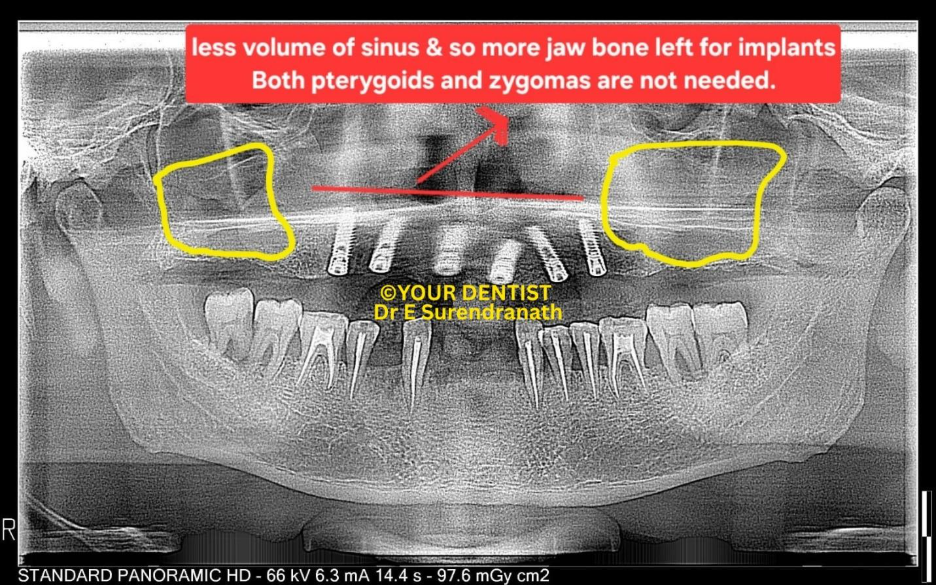
the yellow part marked in each and every x ray shown below,is a maxillary sinus cavity which is a normal anatomic landmark each and every individual have in their skull,but the sinus volume is more and so the jaw volume is less in some individual and in some individuals the sinus volume is less and so jaw volume will be more and in some individuals due to loss of teeth the sinus starts to grow big and thus the jaw bone shrinks and this process is called pneumatization of sinuses. Depending upon the sinus volume and the remaining jawbone, we will decide the treatment plan as per the number of implants ,type of implants , type of remote anchorage , and so on and so forth.
Case 1 – Pterygoid anchorage example
Case 2 – Zygomatic implant example
Case 3 – Nasal floor / anterior remote anchorage example
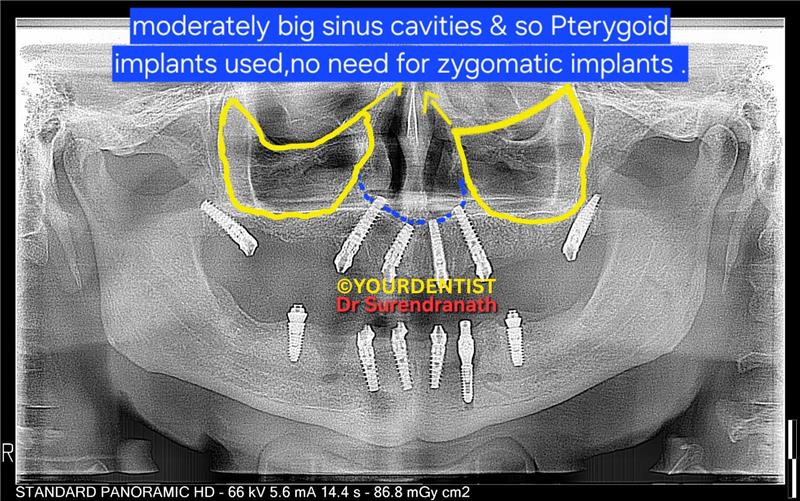
Case 1 here: the anterior jaw bone (front jaw) is good, but the posterior jaw bone (back jaw) is completely resorbed.
In Figure 1, x ray the yellow part marked is a maxillary sinus cavity and when it is of a moderate volume, the posterior bone is scant, or as in this case, there would be no bone at all in the back side of the upper jaw and so he was rejected for implants at a center in nizamabad and so he came all the way to vijayawada to get full mouth implants and pterygoid bone was in abundant and so we used pterygoid bone and the front implants are placed into into the nasal floor for bicortical enagement and gave him fixed teeth in just 7 days.
Without pterygoid implants, we can’t rehabilitate this case with just the remaining front bone of the jaw, and even if done with just 4 implants into the front part of the jaw,they would fail in the coming days, and the long-term prognosis would be very bad.
Fig.1
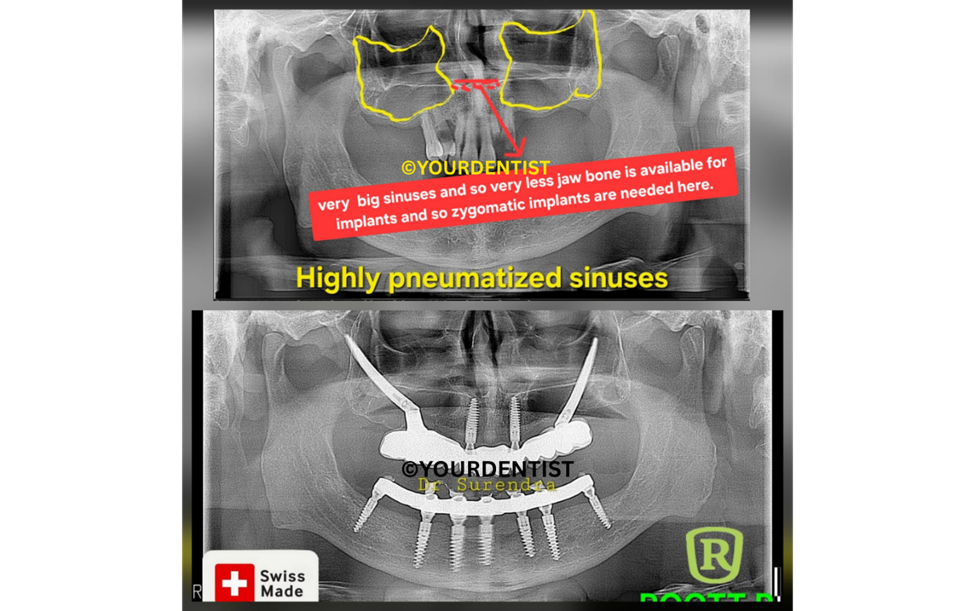
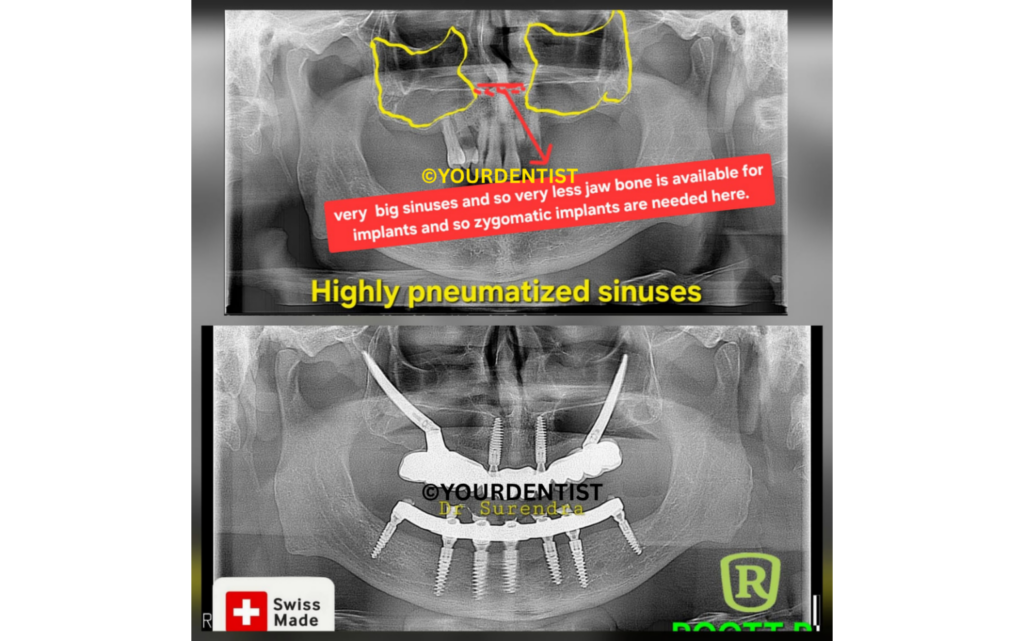
Case 2: In this case, the sinus is very big (highly pneumatized)
And so just 2 implants can be placed in the front jawbone, and the jawbone is completely resorbed from the front to the back region. So, this case warrants a zygomatic implant rehabilitation, and without a zygoma implant, this case is almost impossible to do.
so we engaged the 2 implants into the nasal floor which is the bicortical principle that we always follow and there is no gap for even the third implant here, and with just 2 implants we cant rehabilitate the entire jaw,and surprisingly even the entire tuberosity part of the jaw bone is also gone and the pterygoid bone is also weak in this case, and the only remote anchorage availabkle is the zygomatic bone and hence the treatment p-lan was all on 4 with zygoma.
Fig.2
Case 3: In this case, the sinus is very small.
The front jaw is very good and stable, and also more bone is available in the front region, so we never used any other bone except the jawbone,that is, no remote anchorage at all. It’s a plain, simple, and easy case, and it’s easy for me as a surgeon and for the patient as well.
Fig.3
Conclusion:
Reduced upper jawbone volume does not automatically mean that a patient is not suitable for fixed dental implants. The real question is not just how much bone is present in the maxilla, but whether the surrounding facial skeletal structures can be used intelligently for stable implant support. This is where the concept of remote anchorage completely changes the treatment outlook. By using areas such as the pterygoid bone, zygomatic bone, and nasal floor, even patients with severely compromised upper jaws can often be rehabilitated with fixed teeth in a predictable and biomechanically sound manner. As the live examples in this article show, each case is different, and the treatment plan must always be based on the individual anatomy, bone pattern, and prosthetic requirements. What matters most is proper diagnosis, careful planning, and the experience to choose the right anchorage strategy. So if you have been told that you do not have enough upper jawbone for implants, it may simply mean that you need a more advanced evaluation, not that fixed teeth are impossible.
Restore your smile with advanced dental implants at Your Dentist Dental Hospital. 👉 Consult today